Projects / A real-time bilingual digital avatar, from a GPU server to one Jetson AGX Thor
A real-time bilingual digital avatar, from a GPU server to one Jetson AGX Thor
R&D internship, Industrial Technology Research Institute (ITRI)
Abstract
During my internship at ITRI I built a digital guide for the institute’s museum: a conversational avatar that answers visitors’ questions about ITRI by voice, in English or Chinese, and sees who it is talking to through a camera. The first version generated a lip-synced video of a real person on a GPU server and streamed it to the browser. The second version renders a 3D avatar in the browser instead, which leaves the server only language, speech and vision to run, so the whole system fits on a single NVIDIA Jetson AGX Thor. It serves a 26B-parameter mixture-of-experts LLM at about 38 tokens/s and starts speaking about 1.5 s after the visitor stops talking. The project received ITRI’s Blue Ocean Innovation Award.
What the avatar does
A visitor speaks or types a question in English or Chinese. The system transcribes it, retrieves the relevant facts from a knowledge base about ITRI, lets an LLM write the answer, and speaks it through the avatar with matching lip movement. A camera view tells it whether it is talking to, say, a child or an adult, and it adapts its tone. Voice commands can also be forwarded to a robot through ROS 2 (Figure 1).
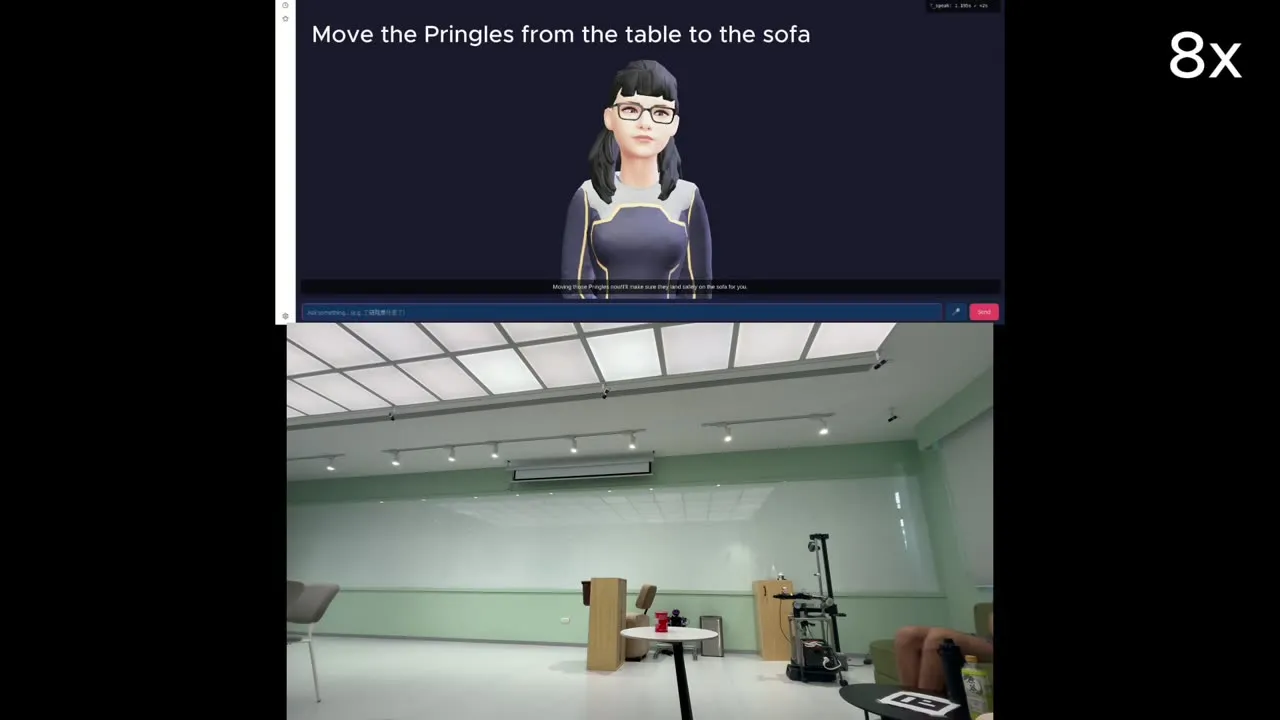
The avatar controlling a ROS 2 robot by voice. Asked to “Move the Pringles from the table to the sofa”, it turns the request into robot commands (object query, navigation, grasp, place; listed on the left) and the robot, seen from the camera below, carries them out. When several tables match, the avatar asks which one and the user picks it by number.
First version: a lip-synced video avatar
The first generation made a video of a real presenter speak. A text-to-speech model turns the LLM’s text into audio; its mel spectrogram drives a lip-sync model (MuseTalk, a latent diffusion U-Net conditioned on Whisper audio features, or the faster Wav2Lip), which repaints the mouth region of the presenter’s reference frames; the frames are composed into a 25 FPS video and streamed to the browser over WebRTC (Figure 2).
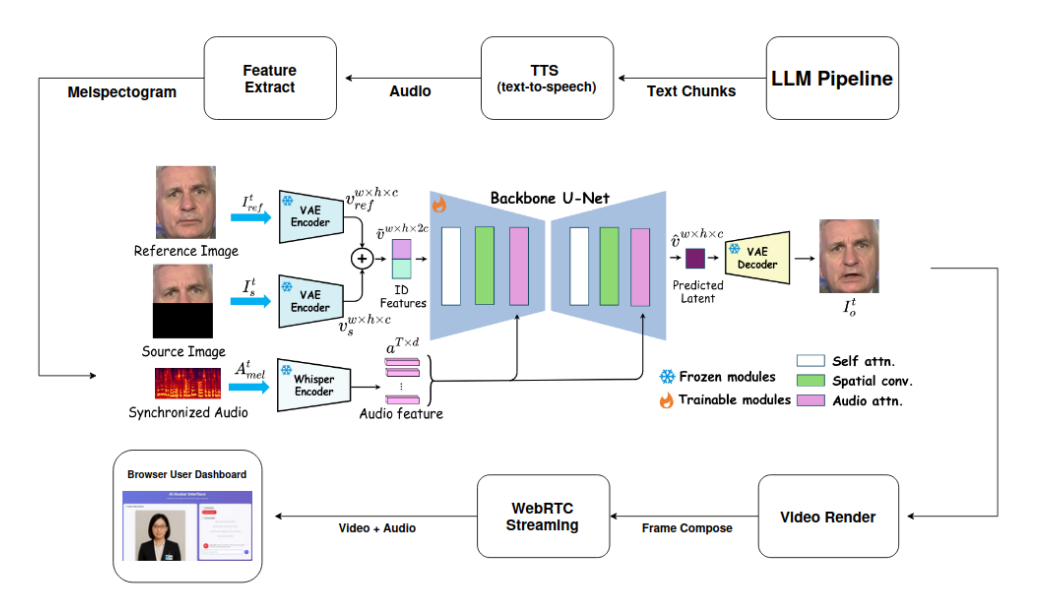
First version. The LLM’s text is spoken by the TTS, the audio drives the MuseTalk lip-sync model frame by frame, and the rendered video is streamed to the browser over WebRTC.
The first-generation system I built has a FastAPI backend with multi-session WebRTC signalling, so that several visitors can talk to their own avatar at once; separate threads for streaming, TTS, audio features, the lip-sync network and video rendering; emotional TTS (OpenAudio S1, with tags such as excited or calm) with a fallback engine; and a small vision-language model (FastVLM) that describes the visitor for the LLM. The cost of this design is that every frame of video is generated on the server: the GPU budget goes to rendering a face.
Second version: a 3D avatar on one Jetson AGX Thor
The second generation moves the face to the browser. A 3D avatar from the open-source TalkingHead library (by Mika Suominen) is rendered with WebGL on the visitor’s device, and the server only sends audio and the timing of each mouth shape (viseme). Freed from video, the server runs everything else on one Jetson AGX Thor with 128 GB of unified memory (Figure 3).
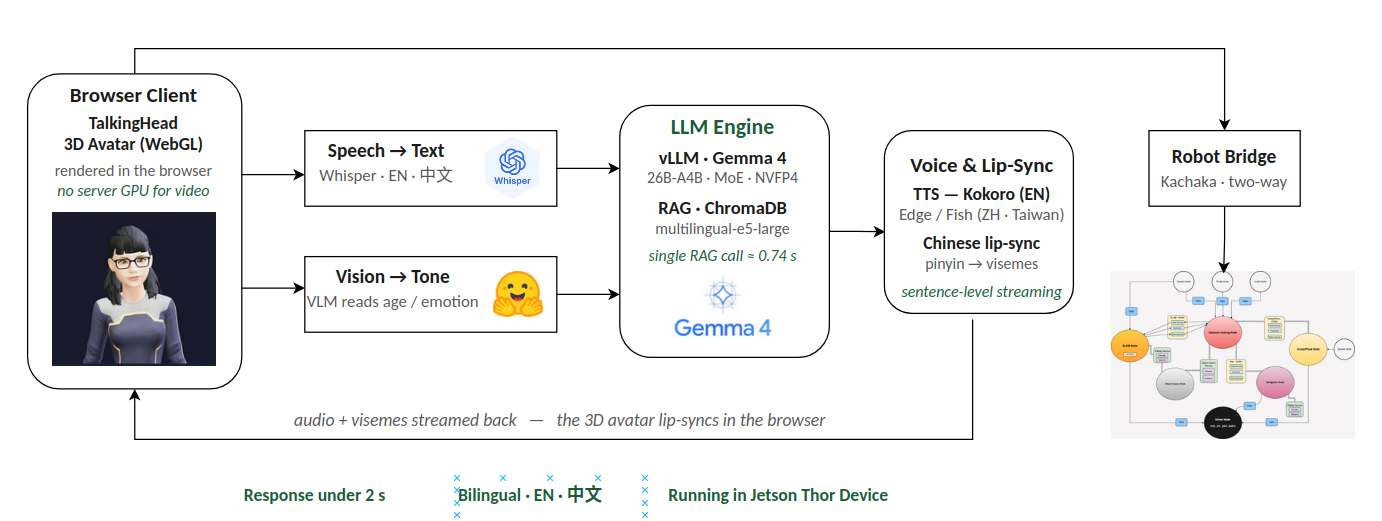
Second version. Speech and camera frames go from the browser to Whisper and a small vision-language model, the LLM engine (vLLM, Gemma 4 and RAG over ChromaDB) answers, and audio with visemes is streamed back to the 3D avatar.
Models of the second version, all on the Jetson AGX Thor.
| Role | Model | How it runs |
|---|---|---|
| LLM | Gemma4-26B-A4B, mixture of experts, NVFP4 | vLLM; about 4B parameters active per token, about 38 tokens/s |
| Retrieval | multilingual-e5-large + ChromaDB | hybrid vector and keyword search, top 6 passages |
| Speech to text | Whisper tiny (int8) | faster-whisper on the CPU, English and Chinese |
| Vision | SmolVLM2-256M | one webcam frame every 5 s, sets the tone |
| Text to speech | Kokoro (English), Edge or Fish Audio (Chinese) | cloud engines fall back to the local Kokoro |
Three pieces of work made it interactive:
- A large model that fits and is fast. NVFP4 quantization of a mixture-of-experts model keeps about 4B of its 26B parameters active per token, so it decodes faster than the avatar speaks. I benchmarked it against Qwen3-30B-A3B in the same format and fit it next to the embedding, speech, vision and TTS models in 128 GB.
- Speaking before the answer is finished. The LLM output is split into sentences as it streams, and each sentence is synthesized and spoken while the next ones are still being generated. With every stage profiled, the first words come about 1.5 s after the visitor stops talking.
- Mandarin lip-sync. TalkingHead has no Chinese module, so the server converts each answer from hanzi to pinyin to visemes with per-character timing, and turns numbers into hanzi (1973 becomes 一九七三) so that they are both spoken and lip-synced.
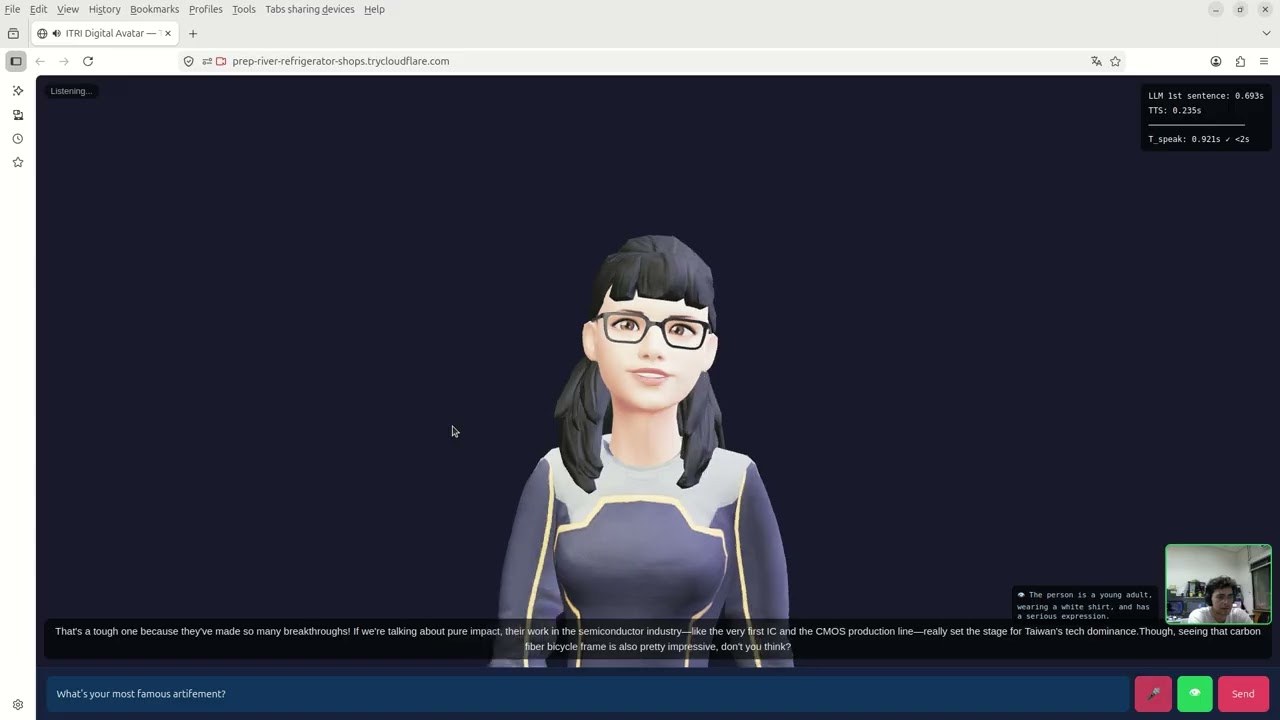
The second version in the English demo: the browser-rendered avatar answers a question while the camera view (bottom right) feeds the vision model. Demos: English and Chinese.
What changed between the versions
The two generations side by side.
| Aspect | First version | Second version |
|---|---|---|
| Avatar | lip-synced video of a real presenter | 3D avatar rendered in the browser |
| Rendering | on the server GPU, every frame | on the visitor’s device (WebGL) |
| Lip-sync | MuseTalk or Wav2Lip on the audio | visemes with word and character timing |
| Sent to the browser | 25 FPS video over WebRTC | audio and viseme timings |
| Hardware | a GPU server | one Jetson AGX Thor, LLM included |
| Chinese | through the video model | server-side hanzi → pinyin → visemes |
Findings
- Rendering the face on the client is what made the edge version possible: without video generation, the Jetson’s memory and compute go to the LLM, retrieval, speech and vision.
- Latency is a pipeline problem: streaming the answer sentence by sentence, not a faster model alone, brought the first words to about 1.5 s.
- A mixture-of-experts model in 4-bit floating point made a 26B model interactive on an embedded board.
- Bilingual details matter: Chinese needed its own lip-sync path and number handling, which the English-only avatar library did not provide.